Tuesday, September 13, 2011

Little Miss Sadies' Special Day


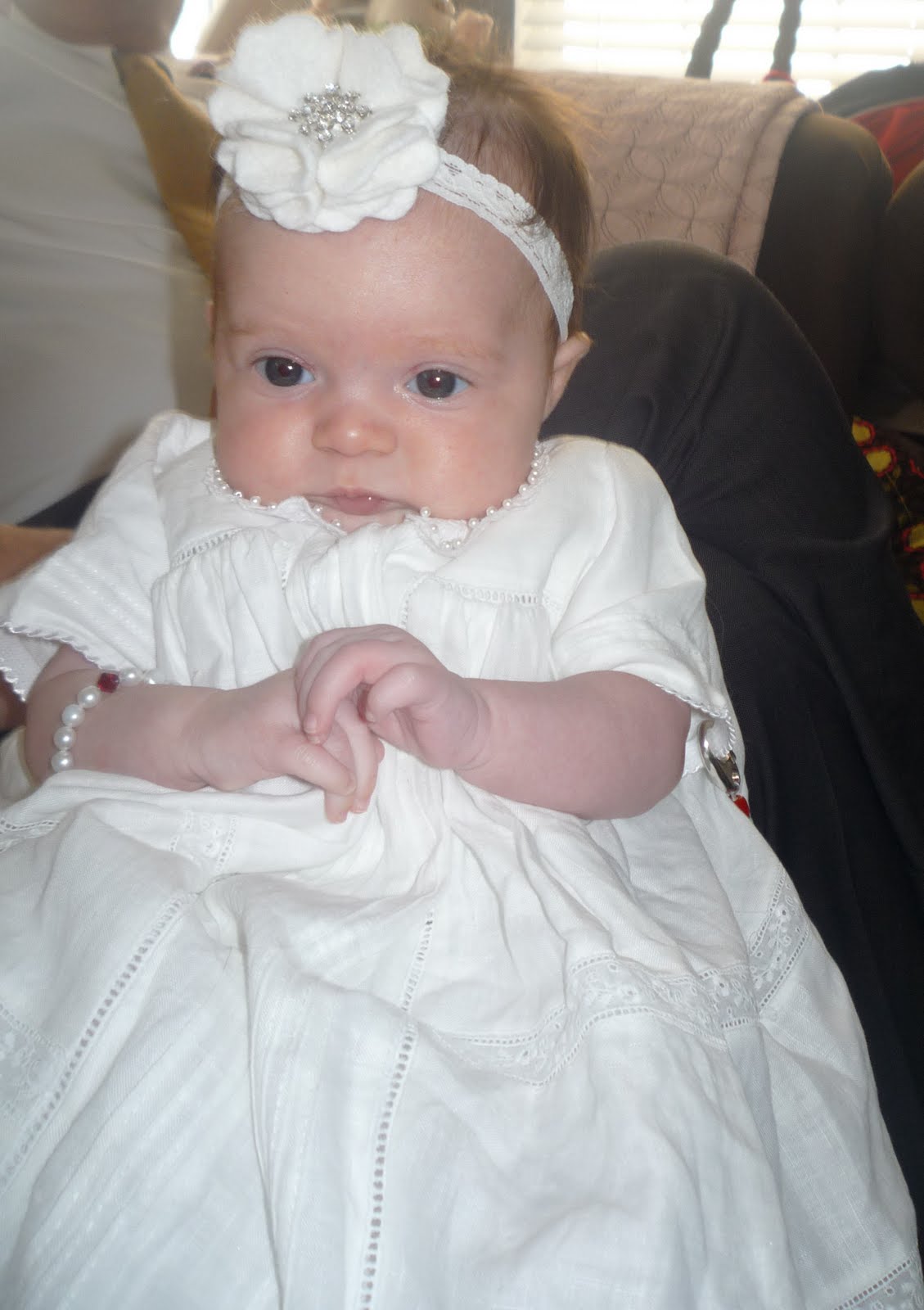
Surrounded by love! I love the day my grand babies are given a name and a blessing! Whether it is in English or Italian, I love that they are surrounded by so much love. That the holy priesthood is used to acknowledge some of the special gifts and abilities that this specific child will have while they are on this earthly journey.

And I love the tradition of creating an heirloom for the event. I have sewn a dress for each one of my grand daughters and quite often the crotchet blanket has been created by the great grandmas. This time Rebekah & Curtis were fairly specific about the style of dress they wanted for Sadies. It was a fun challenge. Though I have sewn since I was like six years old I have never implemented "heirloom" sewing techniques such as lace to lace joining and fabric to lace so you can hardly tell there is a seam.

First, finding the fabrics and laces for this type of sewing was CRAZY! I searched in every fabric store between Provo to Layton. NOTHING-- actually there is a store in Provo but I didn't want to brave the freeway construction. FINALLY! I found a lady in Murray that sells lace on line that would sell it to me out of her house. I found the linen fabric at Little Things Means A Lot factory outlet. By the way-- they have a sale this weekend. Then I had to research the sewing technique. I checked books out of the library and purchased some magazines. But the best place was on-line tutorials-- by Martha Pullen's Sew Beautiful Magazine
created form various pictures and from our our own ideas. Rebekah and Curtis would look at some options and make suggestions, I would sew to that point, then we would continue until it was done. little Sadies' had a few fittings and on the last day a photo shoot with her papa once she was all dressed up. Here are more pictures of that special day. You can also see pics on Bekah's blog


Thursday, September 8, 2011


Photo by Scott G Winterton-- Deseret News

From The Washington Post On Faith - A conversation of Religion and Politics
Posted at 11:38 AM ET, 09/08/2011
9/11 destruction allowed us to spiritually rebuild
By Thomas S. Monson

The calamity of September 11th, 2001 has cast a long shadow. Ten years later, many of us are still haunted by its terrible tragedy of lost lives and broken hearts. It is an episode of anguish that has become a defining moment in the history of the American nation and the world. This week, the Mormon Tabernacle Choir, along with Tom Brokaw, will pay its own homage to the unforgettable events of September 11, 2001.

There was, as many have noted, a remarkable surge of faith following the tragedy. People across the United States rediscovered the need for God and turned to Him for solace and understanding. Comfortable times were shattered. We felt the great unsteadiness of life and reached for the great steadiness of our Father in Heaven. And, as ever, we found it. Americans of all faiths came together in a remarkable way.

Sadly, it seems that much of that renewal of faith has waned in the years that have followed. Healing has come with time, but so has indifference. We forget how vulnerable and sorrowful we felt. Our sorrow moved us to remember the deep purposes of our lives. The darkness of our despair brought us a moment of enlightenment. But we are forgetful. When the depth of grief has passed, its lessons often pass from our minds and hearts as well.

Our Father’s commitment to us, His children, is unwavering. Indeed He softens the winters of our lives, but He also brightens our summers. Whether it is the best of times or the worst, He is with us. He has promised us that this will never change.

But we are less faithful than He is. By nature we are vain, frail, and foolish. We sometimes neglect God. Sometimes we fail to keep the commandments that He gives us to make us happy. Sometimes we fail to commune with Him in prayer. Sometimes we forget to succor the poor and the downtrodden who are also His children. And our forgetfulness is very much to our detriment.

If there is a spiritual lesson to be learned from our experience of that fateful day, it may be that we owe to God the same faithfulness that He gives to us. We should strive for steadiness, and for a commitment to God that does not ebb and flow with the years or the crises of our lives. It should not require tragedy for us to remember Him, and we should not be compelled to humility before giving Him our faith and trust. We too should be with Him in every season.

The way to be with God in every season is to strive to be near Him every week and each day. We truly “need Him every hour,” not just in hours of devastation. We must speak to Him, listen to Him, and serve Him. If we wish to serve Him, we should serve our fellow men. We will mourn the lives we lose, but we should also fix the lives that can be mended and heal the hearts that may yet be healed.

It is constancy that God would have from us. Tragedies are not merely opportunities to give Him a fleeting thought, or for momentary insight to His plan for our happiness. Destruction allows us to rebuild our lives in the way He teaches us, and to become something different than we were. We can make Him the center of our thoughts and His Son, Jesus Christ, the pattern for our behavior. We may not only find faith in God in our sorrow. We may also become faithful to Him in times of calm.

Thomas S. Monson is president of The Church of Jesus Christ of Latter-day Saints.

Sunday, September 4, 2011


I am fascinated by history of Europe between the first and second world wars. I am fascinated by how people lived their lives around some of the most atrocious days of the Holocaust. And this was while my parents were young and falling in love and starting their lives. The little that we know about Rod's great grandparents-- they immigrated to Canada around 1910 and then choose to go back to the Galatia region of Poland (which is now in the Ukraine) in the 1920's. Even though records have them listed as catholic-- with a name like Krajewski I wonder if they converted. Five years ago Rod, Rachael, Gio and I had the opportunity to travel to Krakow and visit Aushwuitz. The next day we traveled over the mountains to Budapest and spent a couple of days there. I don't remember hearing or knowing much about Budapest or even Hungary other then they were a communist block country behind the iron curtain when I was growing up. So when I saw a review about this book LAST YEAR(!) I actually went to Barnes & Noble and bought it. It is a story about 3 Hungarian/Jewish brothers from a small town outside of Budapest starting around 1921. The book then sat around my house for the whole year. I kept hoping someone would read it and tell me if they liked it. But my mom (who reads the ends of the books before deciding to read the whole thing) found it too depressing. Finally knowing I had a weekend trip to San Diego with a lot of down time-- I cracked the cover. And I really enjoyed it. Rarely does a book bring me to tears but at one point when the main character and his parents are saying good bye-- it really hit me -- as a mother, as a daughter, as a human. How difficult those goodbyes were-- not knowing what would be ahead. And also, what difference forks in the road could make. Is it luck or divine providence. And what story is in our history that would inspire people? I recommend this 602 page book and if you want to borrow it-- let me know.

Bear Lake

A few pictures from our weekend in Bear Lake. My camera was on the wrong setting for the lake shots.
We spent two nights in this nine bedroom house that slept 40. A tube slide connected the three levels and both Rod and I have matching skin burns on our knees.


We visited Minitonka Cave over the Idaho border.


And this is what its all about.....

Wednesday, August 31, 2011

THAR SHE BLOWS!!!


Last weekend Rod and I left the 98 degree summer in Utah to a balmy 68 degree sunny San Diego. While there I filled another bucket list or two. I sailed on a masted sail boat the America and I saw a blue whale-- the LARGEST mammal ever! It was a sunset cruise and it was awesome!

This is America's sister ship "The California". It offers a short harbor tour. Our ship had two masts. The California had two masts and cross masts.


Guess what Rod is discussing with his fellow ship matey? Yup..... cameras, lenses, exposure.......!!

This is how the whale takes in food. See the little hairs? It uses those to brush them into their mouths. This sample felt like fiberglass but it is real whale.


This little one stayed safe the whole time by taking a nap in the "hot tub" right under the captain's wheel


Monday, July 25, 2011


This is a picture of somer of my ancestors- The Allen's (my maternal grandmother's family) that settled in Wayne County, UT. In celebrating Pioneer Day I was inspired by these two quotes:

This is an excerpt from A Place of Knowing by Emma Lou Thayne

Many years into my adulthood, when asked by a Jewish poet friend why I stay in my Mormonism, I explained it with a story, the details recounted by my mother. It is my mother’s story transposed into an allegory about my believing.
When I was a little girl, my father took me to hear Helen Keller in the Tabernacle. I must have been about eight or nine and I’d read about Helen Keller in school, and my mother had told me her story.
I remember sitting in the balcony at the back of that huge domed building that was supposed to have the best acoustics in the world. Helen—everybody called her that—walked in from behind a curtain under the choir seats with her teacher, Annie Sullivan. Helen spoke at the pulpit—without a microphone—but we could hear perfectly, her guttural, slow, heavily pronounced speech. She spoke about her life and her beliefs. Her eyes were closed and when it came time for questions from the audience, she put her fingers on her teacher’s lips and then repeated for us what the question had been. She answered
questions about being deaf and blind and learning to read and to type and, of course, to talk. Hearing that voice making words was like hearing words for the first time, as if language had only come into being—into my being at least—that moment.
Someone asked her, “Do you feel colors?”
I’ll never forget her answer, the exact sound of it—“Some-times
. .. . I feel . . . blue.” Her voice went up slightly at the end, which
meant she was smiling. The audience didn’t know whether to laugh or cry.
After quite a lot of questions, she said, “I would . . .. like to ask . . . a fa-vor of you.” Of course, the audience was all alert. “Is your Mormon prophet here?” she asked. There was a flurry of getting up from the front row, and President Grant walked up the stairs to the stand. She reached out her hand and he took it. All I could think was, “Oh, I wish I were taking pictures of that.”
“I . . . would like . . . ,” she said, “to hear your organ . . . play .. . your fa-mous song—about your pio-neers. I . . . would like . . . to re-mem-ber hear-ing it here.” All the time she was speaking she was holding his hand he had given her to shake. I liked them together, very much.
I remember thinking, “I am only a little girl (probably others know) but how in the world will she hear the organ?” But she turned toward President Grant and he motioned to Alexander Schreiner, the Tabernacle organist who was sitting near the loft. At the same time, President Grant led her up a few steps to the back of the enormous organ—with its five manuals and eight thousand pipes. We were all spellbound. He placed her hand on the grained oak of the console, and she stood all alone facing us in her long, black velvet dress with her right arm extended, leaning slightly forward and touching the organ, with her head bowed.
Brother Schreiner played “Come, Come, Ye Saints,” each verse a different arrangement, the organ pealing and throbbing—the bass pedals like foghorns—as only he could make happen. Helen Keller stood there—hearing through her hand and sobbing.
Probably a lot more than just me—probably lots of us in the audience were mouthing the words to ourselves—
“Gird up your loins; fresh courage take. / Our God will never us forsake; / And soon we’ll have this tale to tell— / All is well! / All is well!” I could see my great-grandparents, converts from England, Wales, France, and Denmark, in that circle of their covered wagons, singing over their fires in the cold nights crossing the plains. Three of them had babies die; my great-grandmother was buried in Wyoming.
“And should we die before our journey’s through, / Happy day! / All is well! / We then are free from toil and sorrow, too; / With the just we shall dwell! / But
if our lives are spared again / To see the Saints their rest obtain, / Oh, how we’ll make this chorus swell— / All is well! / All is well!”
So then—that tabernacle, that singing, my ancestors welling in me, my father beside me, that magnificent woman, all combined with the organ and the man who played it and the man who had led her to it—whatever passed between the organ and her passed on to me.
I believed. I believed it all—the seeing without seeing, the hearing without hearing, the going by feel toward something holy, something that could make her cry, something that could move me, alter me, something as unexplainable as a vision or a mystic connection, something entering the pulse of a little girl, something that no matter what would never go away. What it had to do with Joseph Smith or his vision or his gospel I never would really understand—all I know to this day is that I believe.


Gordon B. Hinckley

Gordon B. Hinckley

"Am I an impractical idealist concerning the pioneers? No. There were exceptions here and there, but by and large they were a noble and wonderful people who walked in faith, who lived with loyalty, who were industrious, and who worked with integrity.

Shining above all of their principles and ideals was their solemn and wonderful belief in the Lord Jesus Christ as their Savior and their Redeemer. They knew Him. He walked with them on that long march to the Elkhorn, up the Platte, beside the Sweetwater, over the Continental Divide, and down through the dry and desert country to this valley of the Great Salt Lake. He was their friend. They offered prayers in His name. They sang to His glory. With humble appreciation they spoke of His great atoning sacrifice. They put their faith in Him" (The Teachings of Gordon B. Hinckley, p. 444).